The Super Bowl Commercial Is Dead — Long Live the Cultural Strategy
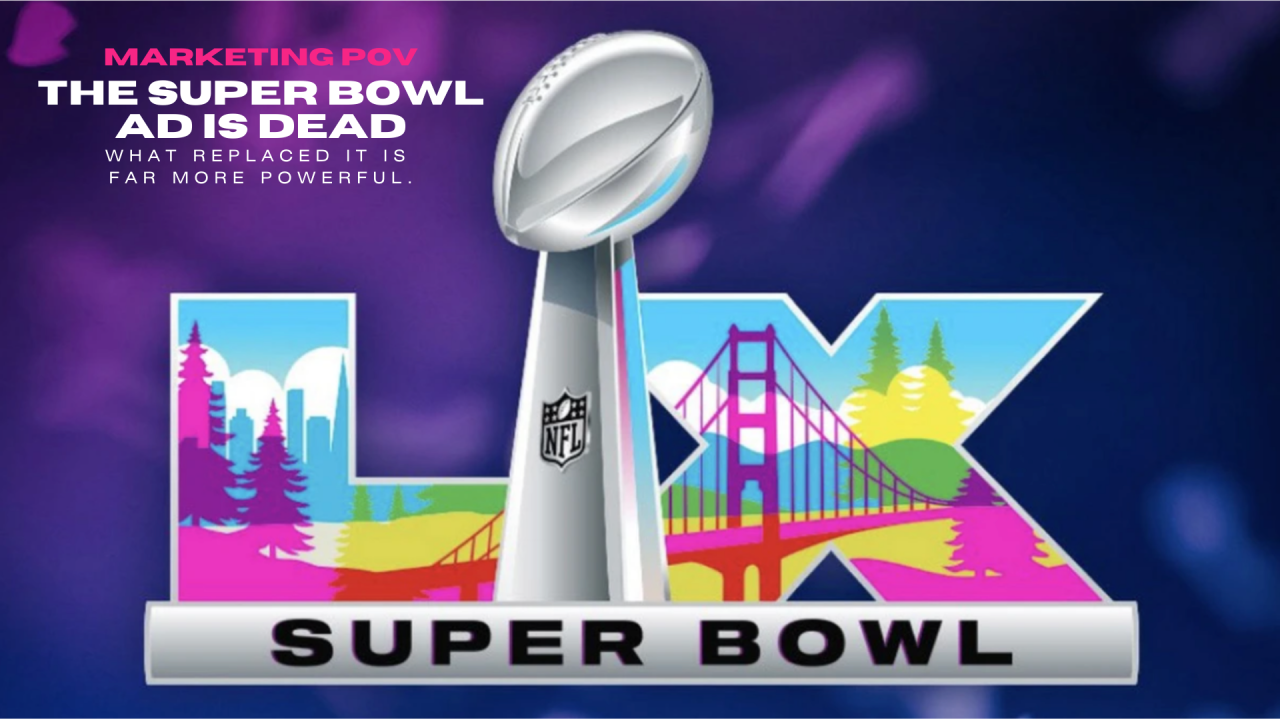
Let’s be honest.
This year’s game lacked tension. But like many marketers, I wasn’t watching for the scoreboard — I was watching for the strategy.
Every Super Bowl Sunday, I look forward to three things:
the snacks
the halftime show
the commercials
And while the football may fade from memory, the advertising landscape told a far more revealing story about where brand marketing is headed.
After reviewing dozens of spots, one strategic reality became abundantly clear:
👉 The Super Bowl commercial is no longer about the 30-second moment. It is about building a cultural narrative that begins long before kickoff and travels far beyond it.
The brands that understand this aren’t spending $8 million.
They’re investing in attention.
The Most Expensive Ad on Television Is Actually Underpriced
Here’s the reality: in a fragmented media environment where attention is scarce and algorithms dictate visibility, the Super Bowl remains one of the few moments when culture gathers simultaneously.
If a campaign drives conversation for weeks…
memes for months…
and brand lift for quarters…
That $8 million quickly shifts from extravagant to strategic.
The real waste?
Running a one-and-done commercial with no surrounding ecosystem.
That’s not strategy. That’s theater.
The brands that treated the Super Bowl as a single media buy rented attention.
The brands that treated it as a cultural platform owned it.
The Death of the “Funny” Super Bowl Ad
For decades, humor was the formula:
Make people laugh → win the night.
But 2026 signaled a shift.
Consumers are no longer impressed by funny alone. They are drawn to:
nostalgia
authenticity
cultural fluency
emotional storytelling
brand self-awareness
Brands like Dunkin’, Instacart, and Squarespace proved that familiarity and narrative depth outperform quick punchlines.
The ads that resonated weren’t just entertaining — they were intentional.
Funny is forgettable. Meaning travels.
AI Didn’t Just Assist the Super Bowl — It Helped Win It
Here’s the strategic reality many brands are still adjusting to:
Your AI marketing partner is becoming as valuable as your creative agency.
Organizations leveraging AI-driven insights can now:
predict audience response
optimize creative faster
personalize messaging at scale
extend campaigns dynamically across platforms
The result? Greater relevance. Stronger engagement. More measurable ROI.
Meanwhile, brands clinging to legacy production models risk creating beautiful work that disappears by Monday morning.
Celebrity Cameos Are Losing Ground to Creator Influence
Another evolution is impossible to ignore:
Influencers are no longer a supporting tactic.
They are increasingly the strategy.
Modern audiences (particularly Gen Z) trust creators more than polished celebrity appearances because creators feel proximal, accessible, and human.
The smartest brands didn’t just cast recognizable faces.
They integrated voices audiences already listen to.
Familiarity beats fame. Every time.
Streaming Changed the Measurement Game
The Super Bowl is no longer just a television event — it’s a multi-platform performance engine.
Streaming has introduced:
real-time engagement data
behavioral insights
immediate sentiment tracking
conversion visibility
For today’s CMOs, success is no longer measured in applause — but in attributable impact.
And in marketing, what gets measured gets funded.
Cultural Relevance > Reach
The scoreboard has changed.
Today, the real questions are:
Did the ad trend? Did people share it? Did it spark conversation? Did it live beyond Sunday?
Reach without resonance is just noise.
The brands that won weren’t chasing impressions.
They were chasing cultural presence.
The Teaser Strategy Is No Longer Optional
Perhaps the clearest signal of maturity in modern brand strategy?
The strongest campaigns didn’t begin on game day.
They began weeks (sometimes months) earlier.
Teasers. Speculation. Creator partnerships. Social breadcrumbs.
By kickoff, the audience was already invested.
Smart brands no longer launch ads.
They launch storylines.
A Strategic Question for Today’s CMOs
Are we entering an era where the Super Bowl becomes irrelevant for brands unwilling to build full-funnel narratives?
Because here’s the reality:
👉 The future of the Super Bowl isn’t 30 seconds. It’s an integrated ecosystem of content.
If your campaign isn’t designed to live before, during, and after the game…
You didn’t buy a strategy.
You bought a moment.
Final Thought
While the final score will blur with time, the brands that understood attention economics will remain.
The Super Bowl was never just about football.
And it’s no longer just about commercials.
It’s about who can capture culture — and keep it.
Expect next year’s Super Bowl to look less like a broadcast and more like a fully integrated cultural launchpad.
The brands preparing now will be the ones we’re still talking about in February 2027.
Now I’m curious:
👉 Which brand won the attention war — not just the humor war?
⭐ Campaigns That Played the Long Game
Several brands demonstrated what modern Super Bowl strategy looks like:
Dunkin’ — Good Will Dunkin’
Budweiser — 150 American Icons
Squarespace featuring Emma Stone
Instacart with Ben Stiller
Lay’s — The Last Harvest
T-Mobile with the Backstreet Boys
NFL — Belief is a Super Power
Poppi Vibes
Levi’s — Backstory
e.l.f. Beauty featuring Melissa McCarthy
Amazon Alexa+
Anthropic AI
Each understood that winning the Super Bowl isn’t about the loudest moment.
It’s about the longest resonance.