Why the Super Bowl Halftime Show Is the Smartest Marketing Stage in the World
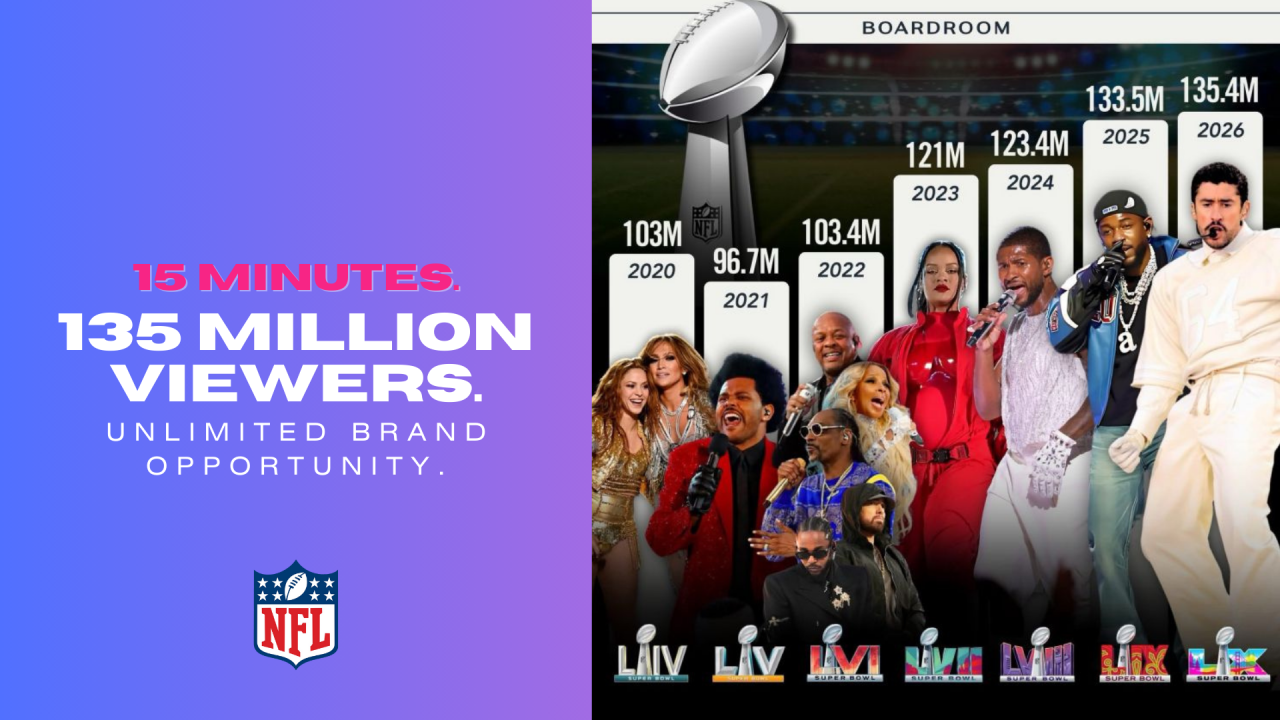
15 minutes.
135 million viewers.
Unlimited brand opportunity.
That is not entertainment. That is one of the most concentrated attention markets on earth.
The Super Bowl halftime show has quietly evolved into the most powerful non-commercial marketing platform in modern media. And this year proved exactly why.
Let’s be honest. The Super Bowl is no longer just a football game. It is a four-hour global marketing spectacle. And for millions of viewers, the halftime show is not the break in the action. It is the main event.
In an era where fragmented media has made mass attention nearly impossible to capture, gathering 135 million viewers is not just impressive. It is a marketing anomaly.
But what many brands still misunderstand is this:
The halftime show is not a performance.
It is a cultural trigger.
And the companies that understand this do not just watch the moment. They strategically orbit it.
Bad Bunny Didn’t Just Perform... He Unified
This year’s halftime show delivered more than spectacle. It delivered symbolism.
Bad Bunny was not simply an artist on a stage. He was the cultural moment.
His performance was vibrant, unapologetic, and globally resonant. It celebrated identity, unity, and cultural pride while reminding audiences that music is one of the few forces capable of transcending language, geography, and politics.
What made the performance particularly powerful from a marketing standpoint was its duality. It gave audiences something joyful and visually electric while simultaneously carrying a deeper message about representation and shared humanity.
That balance is exactly what modern audiences respond to.
Because today, culture drives conversation. And conversation drives visibility.
For brands, proximity to moments like this is invaluable.
When culture moves, attention follows.
And where attention goes, brand equity grows.
When Music Becomes the Marketing Magnet
For decades, the Super Bowl audience was defined primarily by sports fans.
Not anymore.
Today, the halftime show attracts:
music fans
younger viewers
global audiences
pop culture followers
casual watchers who may not care about football at all
In many homes, the game plays in the background while the performance becomes appointment viewing.
That shift is monumental for marketers.
The halftime show expands demographic reach far beyond traditional sports programming. It transforms the Super Bowl from a championship game into a shared cultural convergence.
And cultural convergence is where relevance is built.
Who Really Orchestrates the Halftime Show and Why It Matters
Moments of this scale do not happen by accident.
The halftime show is carefully produced through a partnership between the NFL and Roc Nation, with Apple Music serving as title sponsor.
This is not about booking whoever is trending. It is about selecting an artist capable of commanding global attention and sustaining conversation long after the stadium lights dim.
Artists are chosen based on their ability to:
generate cross-generational appeal
dominate social conversation
drive streaming spikes
attract international media
create cultural momentum
In other words, they are selected for marketing gravity.
For Roc Nation, orchestrating the halftime show reinforces its role as a cultural architect shaping global entertainment.
For Apple Music, the upside is equally strategic:
massive brand visibility
association with cultural relevance
music discovery spikes
subscriber consideration
platform authority
No commercial break required.
Just presence.
The Artist Isn’t Paid. But Everyone Wins.
One of the most fascinating dynamics of the halftime show is that performers are not paid.
Yet the return is extraordinary.
Historically, halftime artists experience immediate surges in:
streaming numbers
global searches
social followers
ticket demand
brand partnerships
Some see catalog increases exceeding 200 percent within days.
Few marketing investments create that kind of downstream impact.
The halftime show functions as what I call a Performance Trigger Event. A single cultural spark that ignites months, sometimes years, of consumer behavior.
Bad Bunny’s post-show trajectory will likely follow this pattern, expanding not only his audience but also the global reach of Latin music and culture.
This is not just exposure.
It is legacy acceleration.
Beyond the $8 Million Commercial
Here is where sophisticated marketers separate themselves from reactive ones.
You do not need a Super Bowl ad to win Super Bowl weekend.
Some of the smartest brands leverage the halftime moment through:
real-time social engagement
creator collaborations
celebrity alignment
cultural commentary
experiential activations
trend participation
They insert themselves into the conversation, already capturing global attention.
Because modern marketing is no longer about interruption.
It is about integration.
Cultural Capital Is the New Media Buy
What the halftime show offers is something money alone cannot guarantee: earned cultural relevance.
When brands align authentically with moments people already care about, they inherit emotional equity.
And emotional equity drives:
recall
trust
affinity
conversation
long-term brand lift
Reach is powerful.
But resonance is priceless.
The Global Multiplier Effect
Unlike traditional Super Bowl ads, which often skew heavily U.S.-centric, the halftime show travels instantly across borders.
Clips dominate YouTube within minutes. Social feeds flood. Streaming platforms surge.
For brands with global ambitions, this is not exposure.
It is borderless visibility.
Owning attention at this scale is rare.
Owning it across continents is strategic gold.
The Strategic Engine Behind the Curtain
Companies like Roc Nation and Apple Music are not participating for prestige alone.
They are building long-term brand positioning.
They are signaling cultural leadership.
They are attaching themselves to one of the last true monoculture moments in media.
In an age defined by fragmented attention, owning culture is one of the most defensible competitive advantages a brand can have.
Final Thought: The Real Marketing Heavyweight
The Lombardi Trophy may go to the winning team.
But the halftime stage belongs to whoever captures global attention.
Because the future of Super Bowl marketing is not confined to commercial breaks.
It lives in shared moments. Collective emotion. Cultural relevance.
The halftime show proves something many brands are still learning:
You do not always have to buy attention.
But you must earn your place inside the moment people cannot stop talking about.
The brands that understand this are not chasing impressions.
They are engineering cultural gravity.
And in modern marketing, gravity is what keeps the world watching.
So the real question is not who won the game.
It is this:
When the world gathered for 15 minutes… Was your brand part of the moment, or invisible inside it?